
How AI is reshaping my calendar
Meetings are context-loading problems dressed up as coordination problems. The architecture from the email system carries over almost without modification.
Last post I argued the entire gap between an AI-augmented CEO and a 100x CEO is context assembly. Email was the first surface where I tested that idea, and the calendar was the next. The architecture pattern carried over almost without modification: meetings are context-loading problems dressed up as coordination problems, and the same approach applies. Pull the right ten thousand tokens into the right window at the right time.
But the architecture wasn't actually the thing pulling me into this work. The thing pulling me in was something I was noticing about my own week.

The thing I noticed
For my whole career, the highest-leverage hours of my week were the ones I spent in meetings. A board member's question would reframe a quarter, a customer call would surface the thing they didn't say, a 1:1 would be where someone finally told me the real reason they were stuck. The room is where the company moves, and that's been true since I started Abnormal.
That stopped being true sometime in the last twelve months. Not entirely, and the room still moves the company on the days it moves the company, but the share of my work that the room actually drives has shifted hard in one direction.
I said it out loud to a colleague a few weeks ago. "The value of my non-meeting time is going up by a factor of 10x, and naturally there are some meetings that are no longer above the cut."
Once I'd said it that way I couldn't go back to running my calendar like I hadn't.
A day on the right IC project used to be a unit of input. Now it can be a unit of company value. A day on the right product bet right now is literally like double the valuation of a day in meetings. When the slope of one curve changes by 5 to 10x and the other stays flat, the rational move is obvious. Spend more time on the steep curve.
I couldn't just delete meetings, because real work happens in those rooms: decisions, alignment, customer relationships, board governance, the part where someone needs to look you in the eye. So the question wasn't how to have fewer meetings. It was how to make every meeting need less of me, so my time in the room is exclusively for the judgment work, and everything else (context loading, transcription, follow-up drafting, action-item tracking, agenda mining) gets pushed out. Most of that doesn't have to happen during the meeting, and a fair amount doesn't have to happen by people at all.
Once you frame it that way, the build path is clear.

What I built
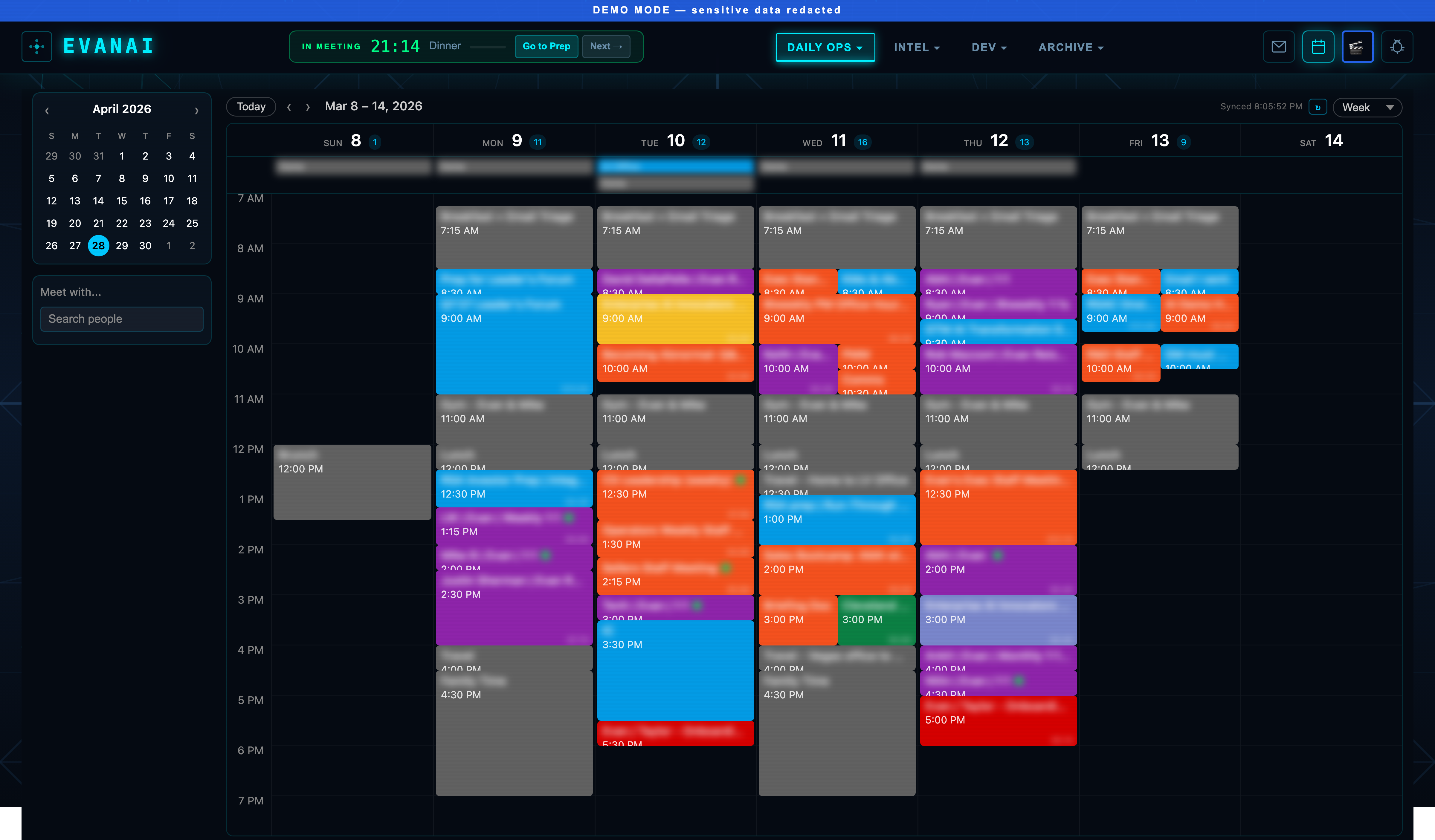
Every meeting on my calendar now has a custom briefing waiting for me before it starts. "Custom" is doing real work in that sentence. The pipeline behind a 1:1 is genuinely different from the pipeline behind a customer call, and both are different from the pipeline behind a weekly operations review. They have to be, because the question I'm trying to answer in each room is different.
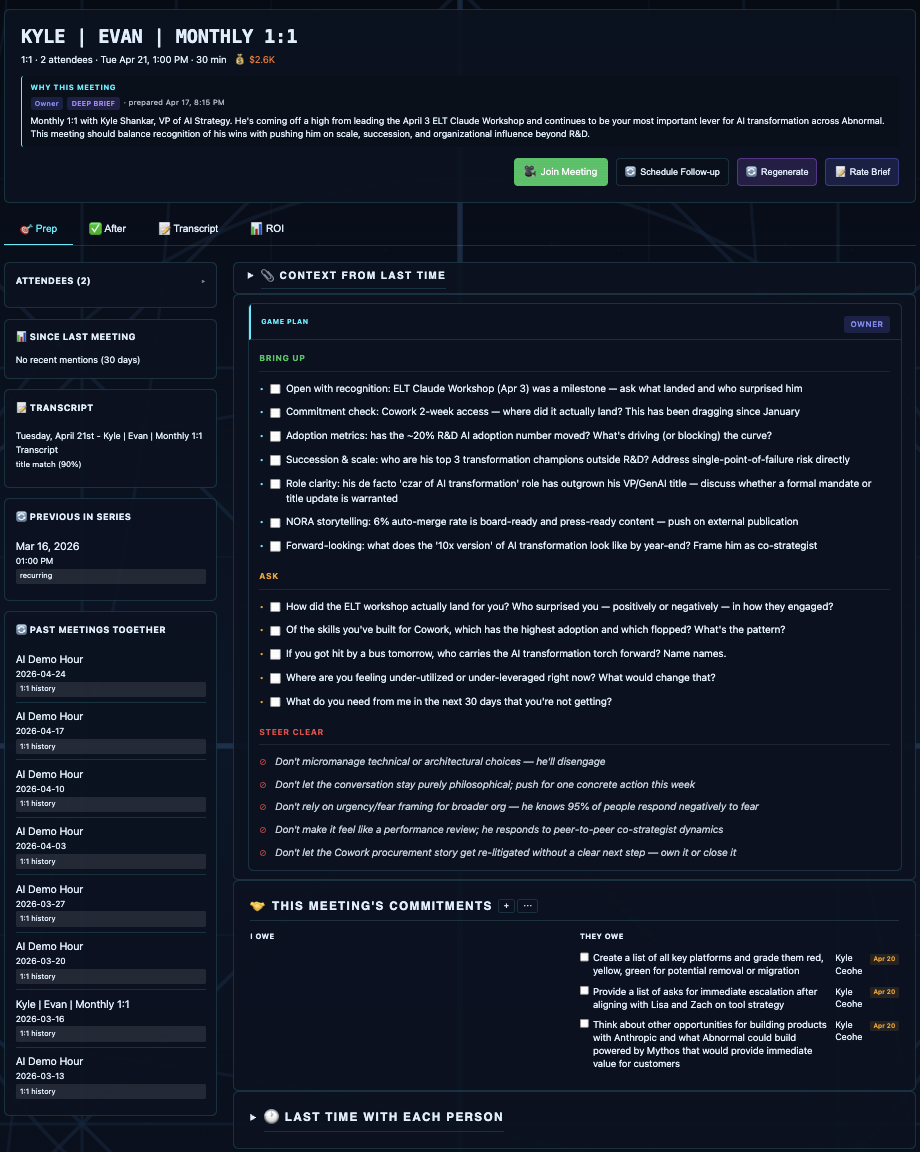
1:1. Opens with open commitments from the last conversation, theirs first (the accountability follow-ups they owe me) and mine second (the status updates I owe them). Then a career or growth thread if we've been building one, and below that, suggested questions to ask and things to avoid given the relationship's recent dynamics. The system pulled all of this from the prior 1:1's transcript, our running commitment ledger, the relationship-health score across our last several meetings, and the person's dossier. I walked into a 1:1 last week at 9:05 and already knew the three things the other person wanted to talk about, not because I'm psychic but because the briefing landed at 9:00 and I spent the next five minutes reading it. The "let me catch you up on context" opener is gone.

Customer or prospect call. A different shape entirely. Customer relationships span dozens of meetings across stages, and the reason a specific call got put on the calendar is rarely sitting in the invite. It's scattered across Slack threads, email exchanges, Salesforce notes, prep docs my team sent over, and Gong moments from the last few calls. So the first thing on the page is what we're actually trying to accomplish in this call, with primary objectives reconstructed from all of those surfaces. Below that, the conversation flow, the tone this customer responds to (Jennifer values directness, lead with data), and a game plan that says when to bring something up and when to wait (Mention the AWS partnership only if they bring it up. They're sensitive about vendor lock-in). Below that, landmines auto-flagged from the data: open escalations in SFDC, a churn signal if their health score dropped, competitive mentions if they're evaluating us against someone, unresolved friction from the last Gong call. Then talking points prioritized for whatever stage of the relationship this call sits in. For prospects (net-new accounts with no relationship history) the same shape adapts, with emphasis swapping to industry, employee count, recommended sales play, discovery questions, and competitive positioning if Glean shows they're actively evaluating someone else.
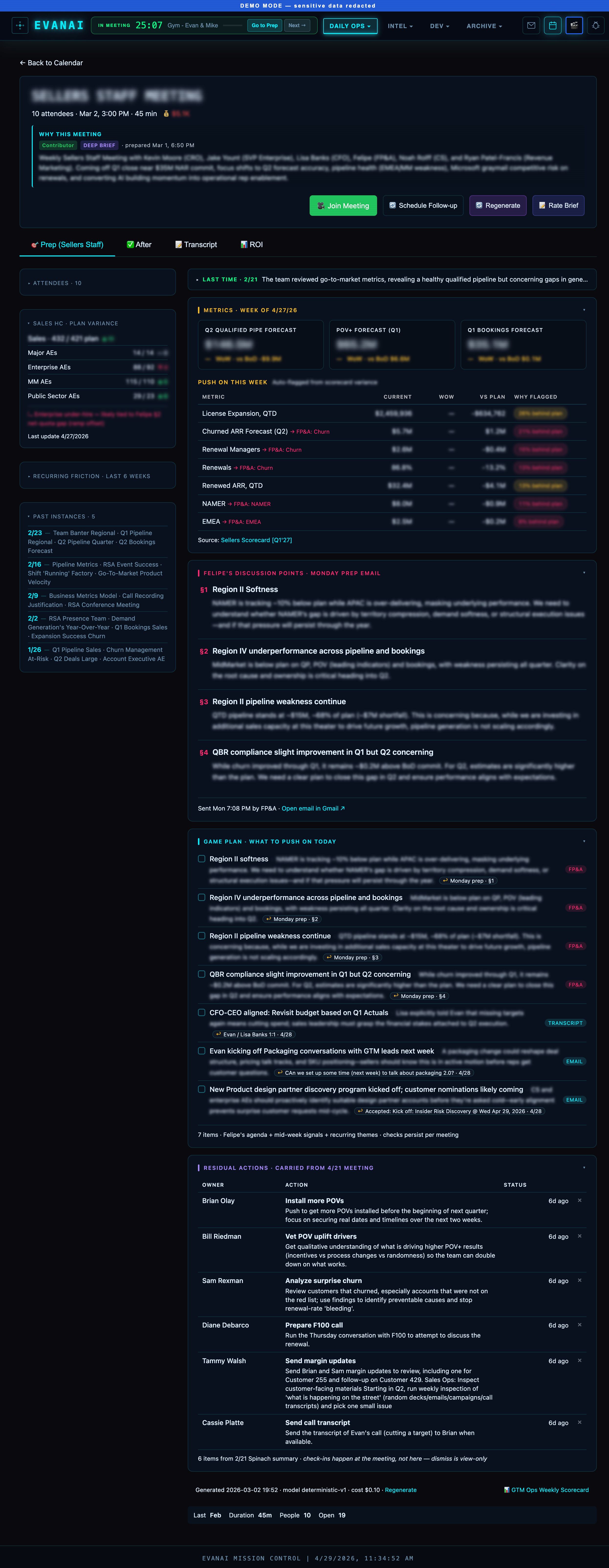
Weekly operational meetings. Sellers, operators, R&D, whatever the function. These are the most deterministic preps I run, intentionally so, because there are real numbers in the room and an LLM hallucinating a regional bookings figure is unacceptable. Each prep opens with the same structure: the prep email from the function head parsed into sections, the scorecard pulled directly from the team's source-of-truth sheet (regional bookings, finance metrics, hiring updates, top initiatives), anomalies auto-flagged (regional flat for two-plus weeks, forecast first-decline, slipped initiatives, items stuck yellow for three weeks), and recurring-friction themes that appeared in two or more of the last five summaries. Then an eight-tier priority game plan that ranks what should get airtime, starting with decisions I owe the team, then my overdue items, then slipped initiatives, then anomalies. The numbers come from sheets, not from a model guessing. Trusted, deterministic, ready before the meeting starts.
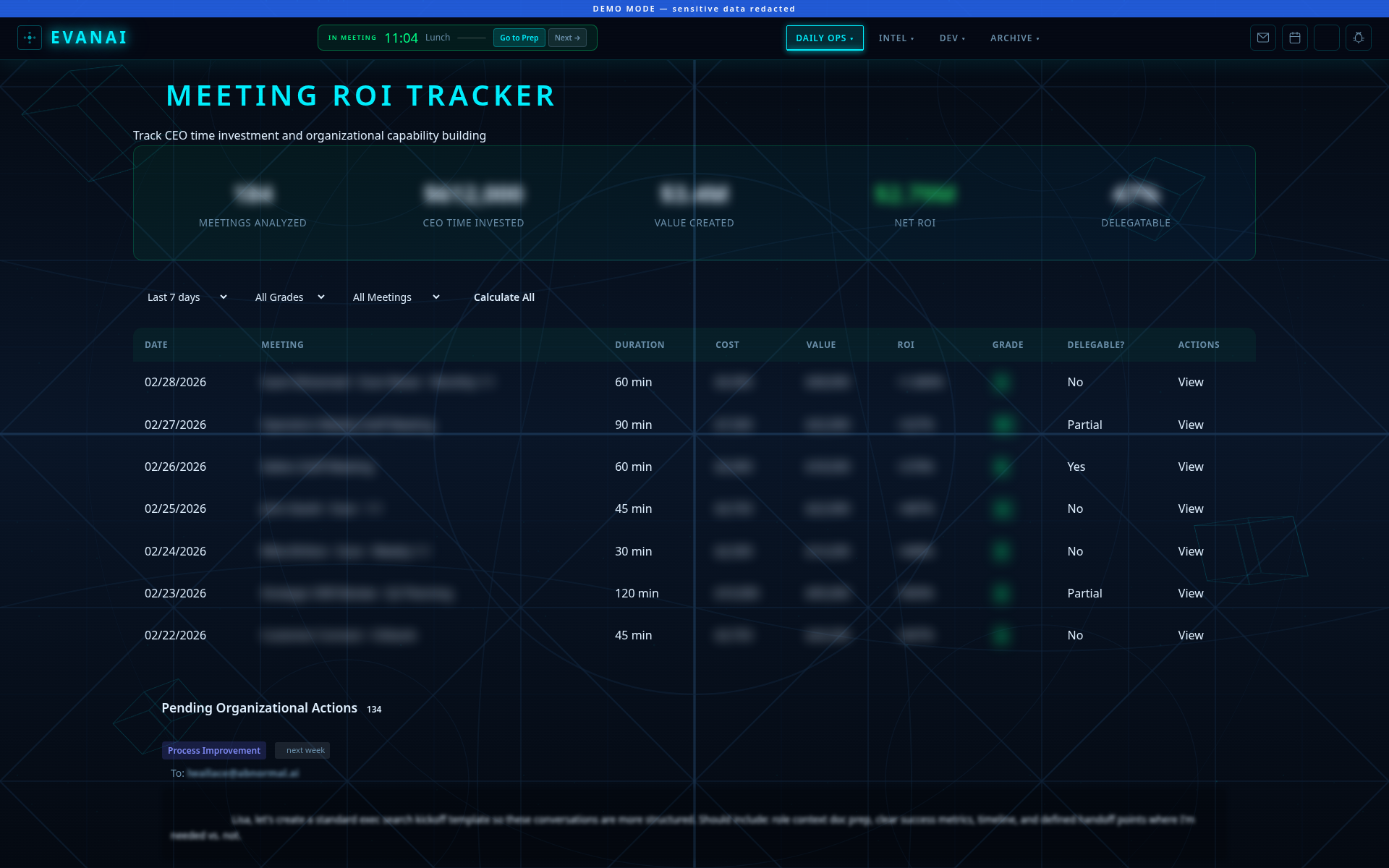
After every meeting, a debrief runs without me asking. It extracts new commitments and writes them to my running ledger, re-checks open commitments from prior meetings (if the transcript shows we resolved one, it marks it closed), and drafts the follow-up email in my voice with the recipient-specific cadence I've been working with that person. That's the email machinery from the last post, plugged into the calendar. It also calculates an ROI on the meeting and flags whether the meeting could have been delegated.
Meetings start at :05 past the hour because the first five minutes are for the briefing to land and for me to get oriented. The meeting still takes its hour. The difference is that none of that hour gets spent on "remind me where we left off," and I walk in already loaded with the right context, so the time inside the room goes a lot further than it used to.

The cost side becomes legible
Once each meeting was analyzed so thoroughly, the cost side of the calendar became legible for the first time. Dollar-cost-per-meeting badges showed up on every invite, time-spent dashboards broke the week down by category, and the 80/20 of my week was finally visible as numbers rather than as a feeling I had on Friday afternoon.

Cost was only half of it. With structured prep on the front and a structured debrief on the back, every meeting now has both a cost and an estimable value: the decisions actually made, the commitments closed, the deal motion produced. Once you have cost on one axis and value on the other, you can start optimizing the calendar for ROI instead of attendance.
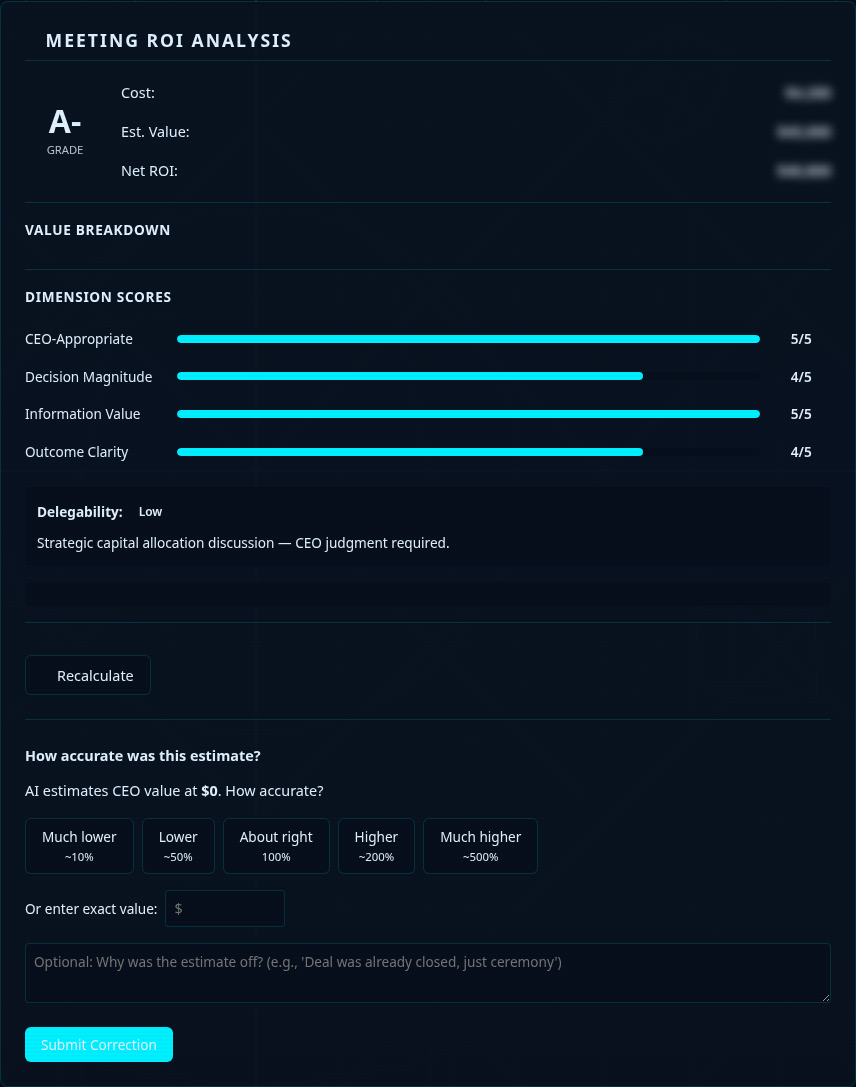
Once you become more aware of where you're investing your time, you become a lot more aware of the opportunity cost. Everything we say yes to is something else we're implicitly saying no to. Hours per week were getting absorbed by meetings I was attending out of habit: recurring 1:1s that hadn't generated a real decision in two months, operational reviews where my presence was a courtesy rather than a requirement. The question for each calendar invite stopped being "can I make time for this?" and started being "does this need me in the room, or can the system handle it?" Most of the time the answer was the second one.

The patterns falling out
Once the math was visible, a few patterns started becoming defaults on my calendar that weren't there six months ago.
- Meetings start at :05. The time-tax of a meeting is the context-reload, not the meeting itself. AI moves that to pre-work, and five minutes of read-time on a tight briefing beats fifteen minutes of "remind me where we are" inside the meeting, every time.
- Consolidate meeting days. Protect IC days. Tuesdays and Thursdays are dense, while Mondays, Wednesdays, and Fridays are mostly clear. The cost of context-switching between deep work and meetings dwarfs the cost of either one alone, and the deep work is where the 10x curve lives.
- Kill the status-update 1:1. A monthly personal touchpoint with each report, plus on-demand co-work sessions where we actually ship something together. One direct told me he feels like I'm investing in him more now than when we were doing weekly status 1:1s, and he's right. We are working on the thing instead of talking about working on the thing.
Every one of these changes is downstream of the same shift. AI took a bite out of what each meeting costs me, and made what I do outside meetings worth more. The calendar is just where the shift becomes visible.

What this is really about
The calendar isn't a schedule. It's a claim about what your time is worth, and AI shifted the math on both sides at once. If you're smart about it, you accomplish the same or more in the meetings you do attend with much less time spent in them, and the rest of the day goes to the work only the CEO can do, where the same AI tools that prep my meetings also make every hour of IC work 5 to 10x more leveraged than it was a year ago. Gains on both sides, and they compound. That's the path to the 100x CEO I made the case for in the first post.
The freed time isn't going to more meetings. It's going to strategic product bets, senior recruiting, brand, and building prototypes the team can iterate on Monday. The CEOs who figure out that amplifying their comparative advantage with AI tools is the operating principle, not meeting throughput, will be playing a different game in eighteen months.
-Evan
Previously in AI × CEO: Rebuilding Gmail for the AI future
Next in AI × CEO: Right words, wrong direction