
Right words, wrong direction
The system learned to sound like me. What it still could not guess was which way I would actually go. So it stopped predicting one reply and started writing every real direction at once.
Two posts ago I wrote about rebuilding my inbox around context assembly, on the bet that the right context makes a decision easy, and email mostly proved it out. The catch is that a system can only assemble the context it can actually see, and that limit is exactly where this post picks up.
By the end of last year the sounding-like-me part was mostly solved. The drafts came back in my voice, to the specific person, with the right context already loaded. What the system still could not reliably guess was which way I would actually go. Accept or decline, push back or let it ride. That was never going to be fully predictable, because the thing that tips the decision often lives somewhere the system cannot see. A text I got an hour ago, a read on the person that has not made it into any document yet, a call I want to make for reasons I could not write down if you asked me to. So I would open a reply expecting to ship it in seconds, and a lot of the time I stopped anyway, because the voice was right but the direction was wrong. A perfectly worded reply in the wrong direction is still the wrong email.
The fix came out of an observation about my own inbox. When you sort email by the decision it actually asks of you, a surprisingly large share collapses into a handful of types, and each type has a short, finite set of directions a reply can take. There are not infinite ways to answer someone asking for my time. There are about four. Do it myself, hand it to the team, decline gracefully, or say yes with a condition. The same is true of a proposal, a question, an escalation. So the system stopped trying to predict the one reply I wanted and started doing something easier and more honest. It names the type of email, lays out the few real directions for it, and writes all of them.
| When the email is a... | The directions it offers |
|---|---|
| Request for your time or help | do it personally · send the team · decline gracefully · yes, with a condition |
| Proposal or recommendation | agree · push back, hold the line · agree with one change · need more before I weigh in |
| Question | answer directly · point them to the owner · answer and ask one back |
| FYI or update | acknowledge · redirect the goal · push on one detail · no reply needed |
| Intro or networking | engage · decline warmly · route to the right person |
| Conflict or escalation | back one side · back the other · de-escalate and reframe · hand to the owner |
Each of those directions is a full draft, not a label. Every one runs the same pipeline as before, my voice profile, the person's dossier, the meeting context, and the positions I have actually taken in transcripts on whatever the email is about. So the "push back" version pushes back the way I would, for the reasons I would, with the conviction I have already argued out loud somewhere. The system recommends the one it thinks I will take and pre-writes the rest the moment the email lands, so by the time I open the reply the directions are already sitting above the draft. I pick one in a tap, and the draft underneath is the one already written for that direction, so it appears with no wait. A warm, neutral, or brief toggle does the same for tone. The pick steers the engine without replacing it, so the quality of the writing never changes and only the direction does. Most replies are now a couple of clicks.
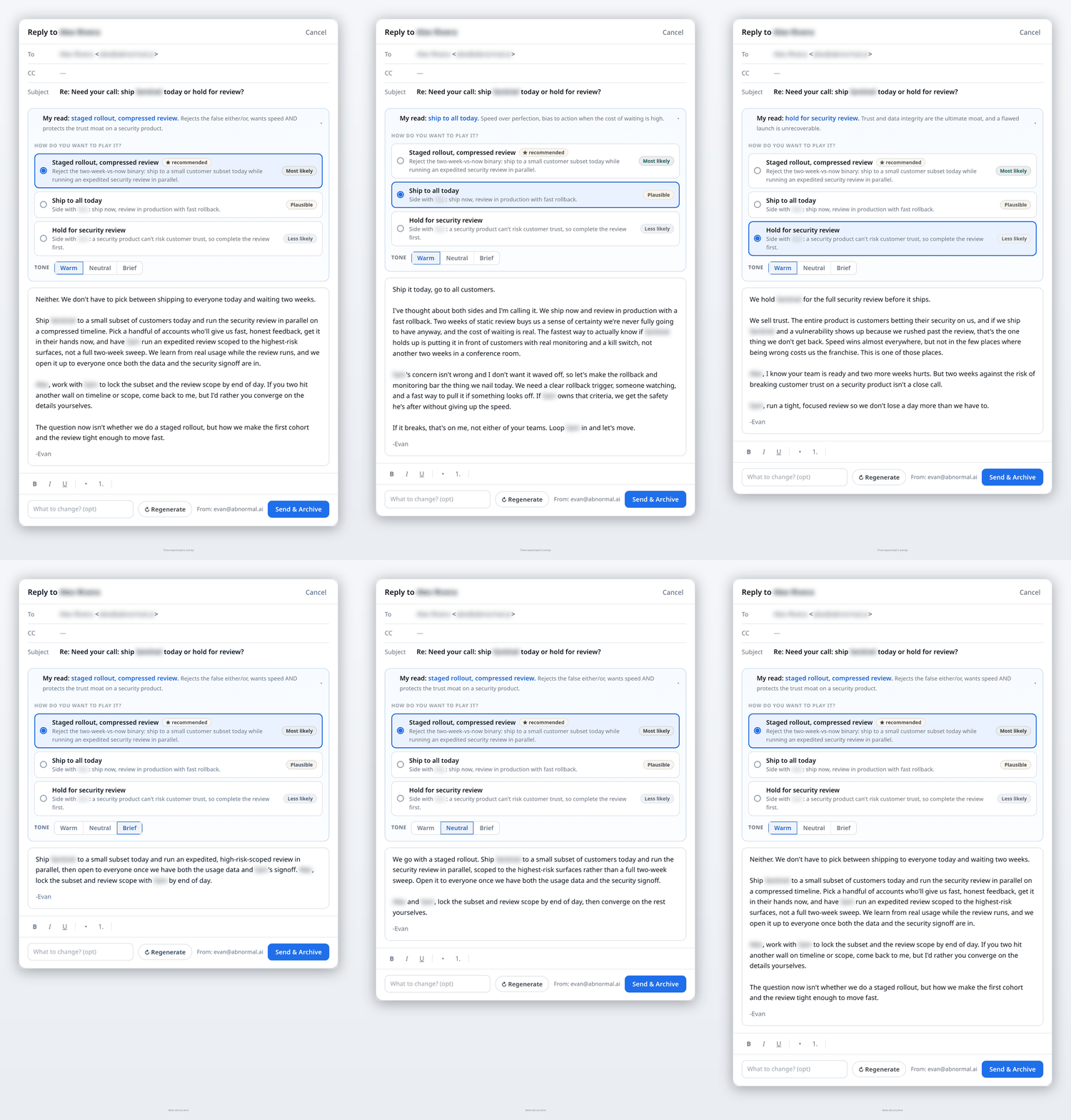
Every choice I make, and especially every time I override the direction it recommended, is a clean piece of data about which way I lean on that kind of email from that kind of person. It is a better signal than anything I could write down about how I decide, because it is the decision itself. The defaults land right more often the more I use it, the overrides get rarer, and the thing that was hardest to predict, not how I would say something but what I would decide, is the thing that now compounds. And even when it guesses the direction wrong, the miss barely costs me anything, because the one I actually want is likely already drafted and a tap away, so correcting it usually takes a click instead of a rewrite. That is the path to running close to all of my outbound through the system instead of most of it.
I still hit send, and I expect I will for the foreseeable future, but more and more I am selecting from an extremely well-informed menu rather than writing the words.
-Evan
Previously in AI × CEO: How AI is reshaping my calendar
Next in AI × CEO: The software that fixes itself