
Naming the conundrum
How I explain competing objectives, the cost of either extreme, and the tradeoffs that help people develop their own judgment.
To me, naming the conundrum means telling people which goals pull against each other, why each matters, and what goes wrong at either extreme. I want people to understand that we're pursuing both goals, and that a gain on one can cost us too much on the other. With that context, they can make a good call on a tradeoff we've never discussed.
When one objective crowds out the other
Most engineers care about speed and quality. The best are intentional about the tradeoffs and look for ways to get more of both.
A well-intentioned product leader who hears “ship faster” can pass it on as “hit the date at any cost.” The same person might hear “quality comes first” and tell the team “nothing ships until it's perfect.” The team can end up sacrificing something we all value because they believe that's what I asked them to do.
A more effective way to communicate the tradeoff
Naming the conundrum helps when I'm giving direction and when I'm asking for advice. Someone who knows what I'm weighing can point out a benefit I've missed or a cost I've underestimated. Here's how I'd frame a decision about when to ship.
- State both objectives.
- Speed. “When we ship quickly, customers benefit sooner and we get to learn from how they use the software.”
- Quality. “We want to build a product customers love because it reliably delivers the results they need.”
- Name the tension. “More work on reliability can give customers a better product, but it can also mean they wait longer to use it.”
- Explain the cost of either extreme.
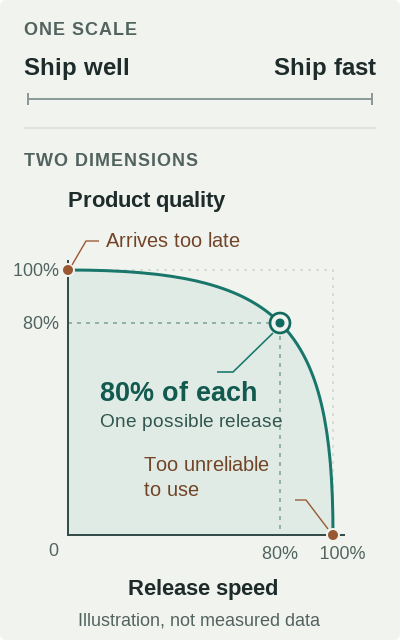
- Speed alone. “If we rush out something unreliable, customers may lose trust in us.”
- Quality alone. “If we wait for perfection, we may be too late to help them.”
- Ask for a recommendation. “What would you recommend? What would that choice mean for how soon customers get the product and how well it works for them?”
“Fast or good?” puts speed and quality at opposite ends of one scale. A release can be late and unreliable, just as it can ship quickly and work well. It takes two axes to show those possibilities.
Developing judgment across the team
Before I give direction, I think about what would happen if someone did exactly what I asked. What might they think I've given them permission to ignore?
When a leader brings me a recommendation, I ask, “What are the objectives you're optimizing for, and how do you think about balancing those?” If they mention only one goal, I want to know whether the others were missing from the decision or just from the explanation.
I encourage those leaders to explain their own tradeoffs to their teams and ask the same question when someone brings them a recommendation. When circumstances change, someone I've never spoken to can make a different call and explain why it still serves both goals.
-Evan